

The RTP/FedNow–Stablecoin Equivalence
What Stablecoins Can Learn from RTP and FedNow

A few weeks ago, Steve Ledford, whom I consider the godfather of RTP, co-wrote a great piece in Digital Transactions about why real-time payments in the US are yet to have their “hockey stick” moment.
For those of us who have studied, built around, and obsessed over RTP and FedNow from the beginning, the article hit a nerve. And I couldn’t help but wonder: are the people now laser-focused on stablecoins as the future of payments seeing the resemblance?
RTP and FedNow are faster, richer, always-on payment rails. And yet, volumes are still tiny compared with ACH, the less glamorous but extremely entrenched payments rail.
That should sound familiar. Strip out the noise and the stablecoins curve flattens considerably.1
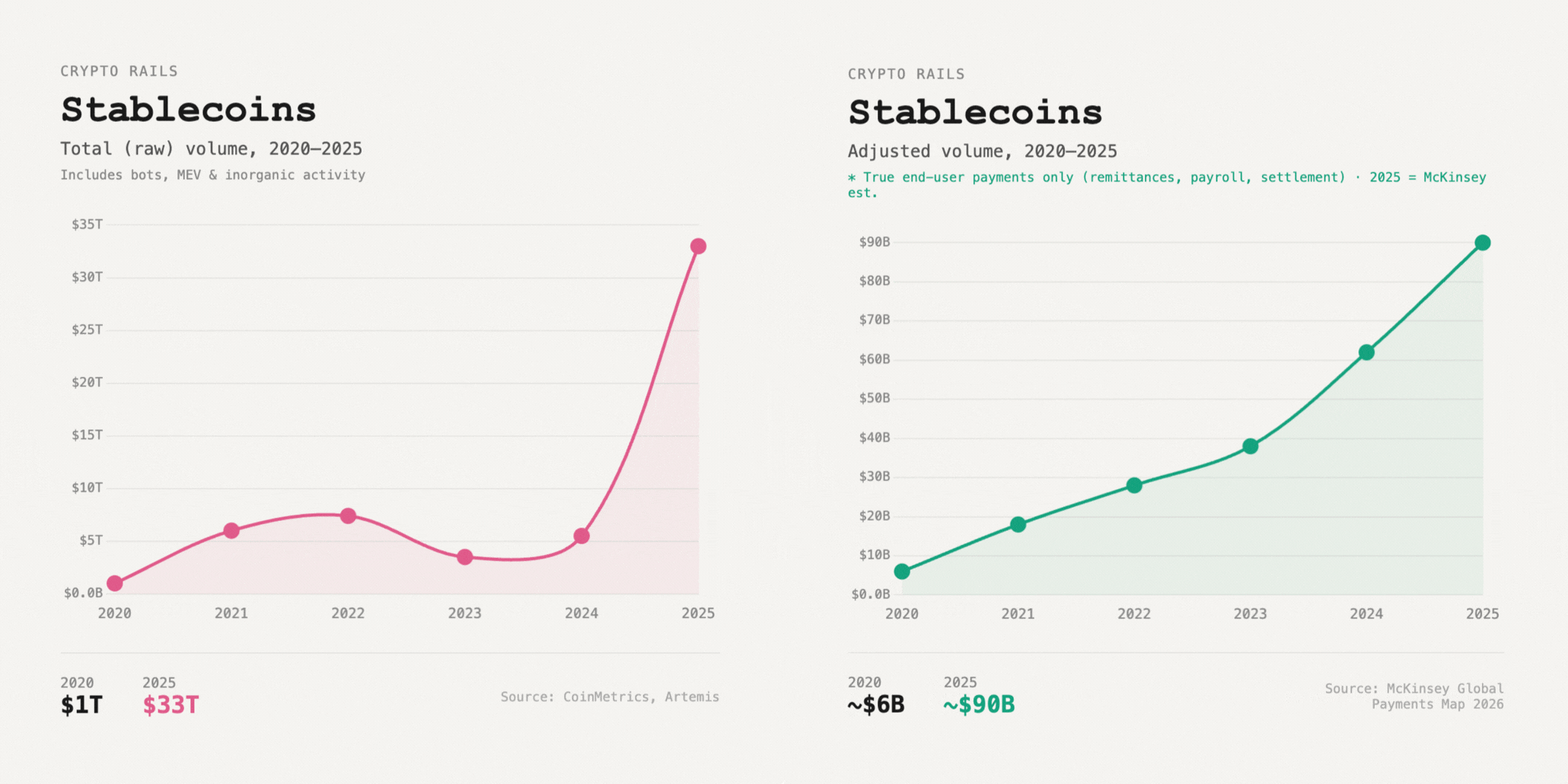
Stablecoins may be faster, programmable, global, and always on. But as FedNow and RTP have taught us, technical superiority doesn’t guarantee adoption. The best rail doesn’t win because it is elegant, it wins when and if it disappears into the products, workflows, and back-office systems people already use.
And payments have a lot of all of the above.
To disappear, payment infrastructures need to be able to seamlessly speak to all the systems that do all the boring but essential things like: message validation, payment status, fraud controls, reconciliation, liquidity management, exception handling, customer support, disclosures, governance, and rules for what happens when things go sideways.
Moving money is half the job, the other half is moving information. So I wanted to breakdown some of the key learnings that stablecoins could borrow from the RTP/FedNow experiments.
Ubiquity Beats Elegance
As Steve and Lee point in their article, RTP and FedNow had a distribution problem. ACH, cards, Zelle, wallets, push-to-card services, and bank products already had reach when they came around. And they were embedded in the places consumers and businesses already lived.
Stablecoins have the same problem, with extra plumbing.
I often hear that stablecoins already have global reach because public blockchains are open. Technically, yes. Practically, not quite.
For stablecoins to have meaningful reach, the industry needs things like custody, compliance, fraud controls, accounting tools, tax reporting, merchant settlement, bank connectivity, and liquidity management. Some which exist, but nowhere near the level that traditional payments offer.
A business doesn’t just need to “receive a payment.” It needs to know who paid, why they paid, whether the payment is compliant, how to reconcile it, if needed how to convert it, how to refund it, how to report it, and how to explain it to finance, legal, and auditors.
Ubiquity isn’t just the ability to send a token to any wallet address. Ubiquity is the ability to pay the right person, in the right format, with the right information, under the right rules, in a way both sides can actually use.
Real-Time Payments Create Real-Time Operations
Instant payments are not like regular payments but faster. They fundamentally change the operating model of financial institutions.
If payments move 24/7/365, the support model, fraud model, liquidity model, reconciliation model, and escalation model also need to work 24/7/365.
A stablecoin transfer may settle in seconds on-chain, but someone still has to answer the boring-but-essential questions:
Who reconciles it? Who monitors fraud? Who handles a failed payment? Who helps the customer on Sunday night? Who explains why the blockchain worked but the compliance process did not?
Without this operational muscle, we end up with a weird paradox: the payment settles instantly, but the business cannot make sense of it until later. Most people would be amazed by the amount of manual steps that occur inside banks even to this day.
Liquidity Is the Hidden Product
Payments look simple from the outside: tap, send, receive, done.
Behind the scenes, liquidity is doing all the work.
Instant payment systems require funding, forecasting, intraday liquidity management, weekend planning, reconciliation, and contingency arrangements. Stablecoins have all of that, plus issuer and reserve risk.
Stablecoins face liquidity questions at every layer:
Does the user have the right asset on the right chain? Can the platform support conversion and refunds? Can the market exchange the stablecoin at par? Can the issuer meet redemptions under stress? Can the reserves be turned into cash quickly without losses?
That last part matters.
Stablecoins are not just payment instruments. They are privately issued monetary claims. Their value depends on reserves, redemption processes, liquidity, issuer risk management, and market confidence. If users suddenly want out, even high-quality reserves may need to be sold quickly. That starts to look less like the future of money and more like bank run.
Stablecoins promise instant digital money. But the stress test still lives in the old world: cash, treasuries, banking relationships, redemption windows, market depth, and confidence.
The rail may be on-chain. The panic is still very TradFi.
Finality Is Great Until It Is Not
There’s this saying around the industry: “Faster payments, faster fraud”. Instant payments and stablecoins share a unique feature: once money moves, it may be very hard to get back.
That is wonderful for settlement certainty. It is less wonderful when someone sends funds to the wrong wallet, falls for a scam, pays a sanctioned party, or realizes five seconds too late that “0x7f…” was not, in fact, their vendor.
Traditional payments have reversals, disputes, chargebacks, returns, investigations, behavioral monitoring, customer protection frameworks and escalation paths. They are imperfect, but they exist for a reason.
Finality doesn’t only exacerbate mistakes, fraud, or compliance issues, it also makes them more urgent.
Governance Turns Rails Into Infrastructure
Payment systems run on something not very elegant but very durable: rules, agreements, disclosures, warranties, indemnities, liability allocation, regulatory obligations, and error-resolution procedures.
A business deciding whether to use stablecoins does not only ask, “Can this settle faster?”
It asks:
Who is responsible if something goes wrong? What protections apply? What happens if a payment is misdirected? What if a wallet provider, issuer, custodian, exchange, or bridge fails? What law governs the transaction? What records must be retained? What happens across borders?
Until those answers are clear, stablecoins will remain a powerful but uneven infrastructure.
Payments at scale require technology. They also require rules all stakeholders can trust.
The Takeaway
If this sounds like a laundry list of things that the industry needs to build, that’s because it is.
In some cases, incumbents are best positioned to build, in others, startups may be the ones that make a meaningful dent. The real question is which players can thrive where, and the answer depends on the complexity of the integrations. Some of these opportunities sit far too deep in the infrastructure for new entrants to realistically tackle.
But if RTP and FedNow have taught us anything, it’s that the market doesn’t need “instant settlement” packaged as a consumer-facing product. It needs instant-payment rails that quietly make other products better, and for the underlying systems to be more rail agnostic. Without this, adoption is slow, painfully slow.
I’m looking at the volume data across 2020 to 2025 and extrapolating the McKinsey estimation methodology to adjust for inorganic activity. There’s no perfect way to do this, the data is messy before 2024, the methodology to separate organic from inorganic activity didn’t exist in a standardized, published form. But what we do not is that it is highly inflated and consists mainly of trading, internal shuffling of funds, and automated blockchain activity.
"Stablecoins have the same problem, with extra plumbing." This encapsulates the precision of your analysis. In B2B the plumbing matters more than execution speed. In P2P, C2B the battle against the Venmos, card rebates, direct debit seems unwinnable now. On the bright side though: for real estate closings on a Sunday afternoon it's unlikely stablecoins will crush RTP/FedNow.
This piece captures especially well that payment speed and operational usability are not always the same thing. Real-time movement only matters if the surrounding systems can interpret, reconcile, and act on the information fast enough to support decisions.